
Kultur und Natur
Biosphärenreservate

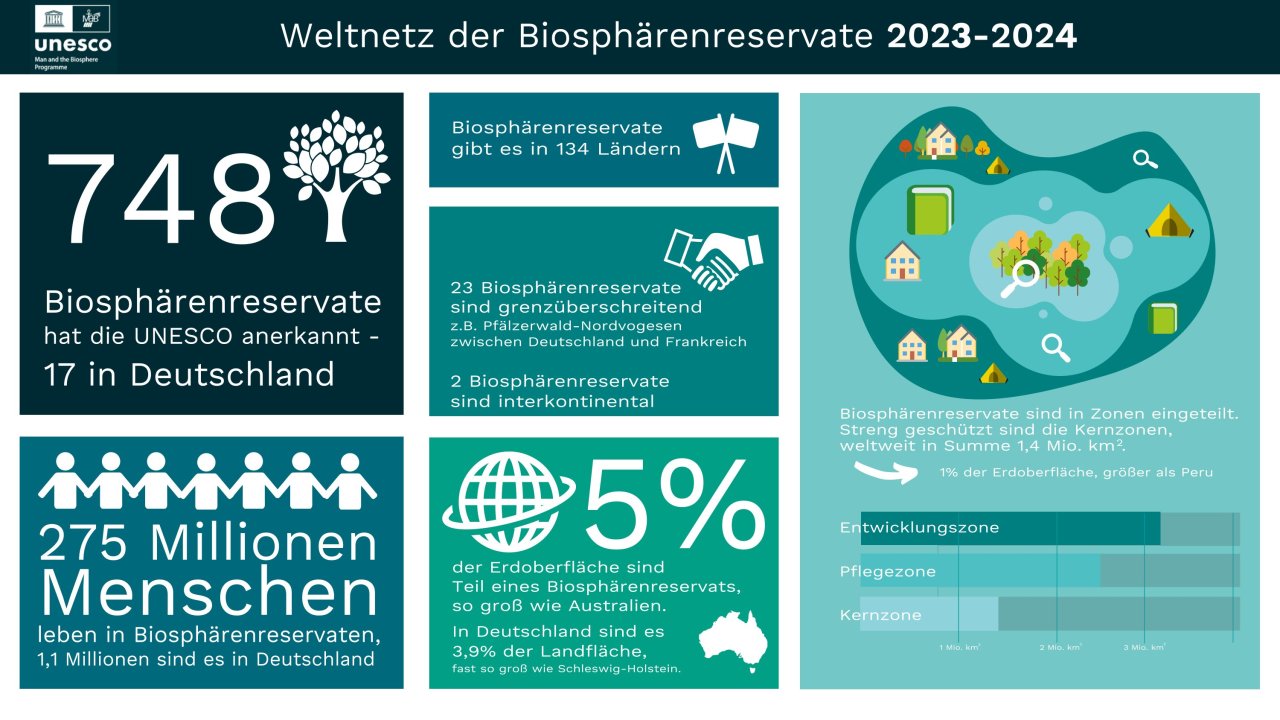
Wie kann in einer konkreten Landschaft nachhaltige Entwicklung gelingen, wie kann man dort Naturschutz und Wirtschaft zusammen bringen? Wie kann man das Wissen über erfolgreiche Ansätze weltweit teilen? Die UNESCO zeigt dies mit ihren 748 Biosphärenreservaten weltweit, Modellregionen und Lernorten für nachhaltige Entwicklung, in 134 Ländern. In Deutschland gibt es 17 UNESCO-Biosphärenreservate.
UNESCO-Biosphärenreservate
748 Biosphärenreservate weltweit in 134 Staaten – 17 davon in Deutschland.
Ein Biosphärenreservat erfüllt verschiedene Aufgaben: Es fördert nachhaltige Wirtschaftsformen, Naturschutz, Forschung und Bildung für nachhaltige Entwicklung ebenso wie internationale Kooperation. Ein Biosphärenreservat ist in Zonen unterteilt, in denen unterschiedliche Regeln gelten. Es muss für einen besonderen Naturraum repräsentativ sein – noch wichtiger sind aber die Menschen im Gebiet und ihre möglichst naturschonenden Lebens- und Wirtschaftsformen. Biosphärenreservate stehen für einen Paradigmenwechsel: Naturschutz mit und durch den Menschen. Sie bieten Rahmen für langfristige Nachhaltigkeitsprozesse und halten eine Landschaft somit „lebensfähig“. Sie sind ein Qualitätssiegel für Touristinnen und Touristen, sie stehen für neue Einkommens- und Beschäftigungschancen ebenso wie für Identität und Stolz auf eine Region in einem Weltnetz. Sie tragen bei zu internationaler Zusammenarbeit und Frieden. Der Weg zur Anerkennung ist nicht einfach, bringt aber nachweislich große Erfolge.
Das Verständnis für die Bedeutung von Biosphärenreservaten als Instrument für die Agenda 2030 weltweit zu fördern und internationale Partnerschaften im Weltnetz auf den Weg bringen zu helfen, ist ein Schwerpunkt der Arbeit der Deutschen UNESCO-Kommission.